
A corporate lobby or office LED display is often the first impression a business makes on clients, staff, and visitors. In Perth's commercial property market, with its large-glazed facades, high-footfall CBD office towers, and premium fitout standards, the right indoor LED display Perth specification makes a measurable difference. The wrong one washes out in ambient light or creates content management problems that become operational burdens. This guide helps facility managers and fitout decision-makers navigate the choices that actually matter: display size, pixel pitch, brightness, content strategy, and installation.
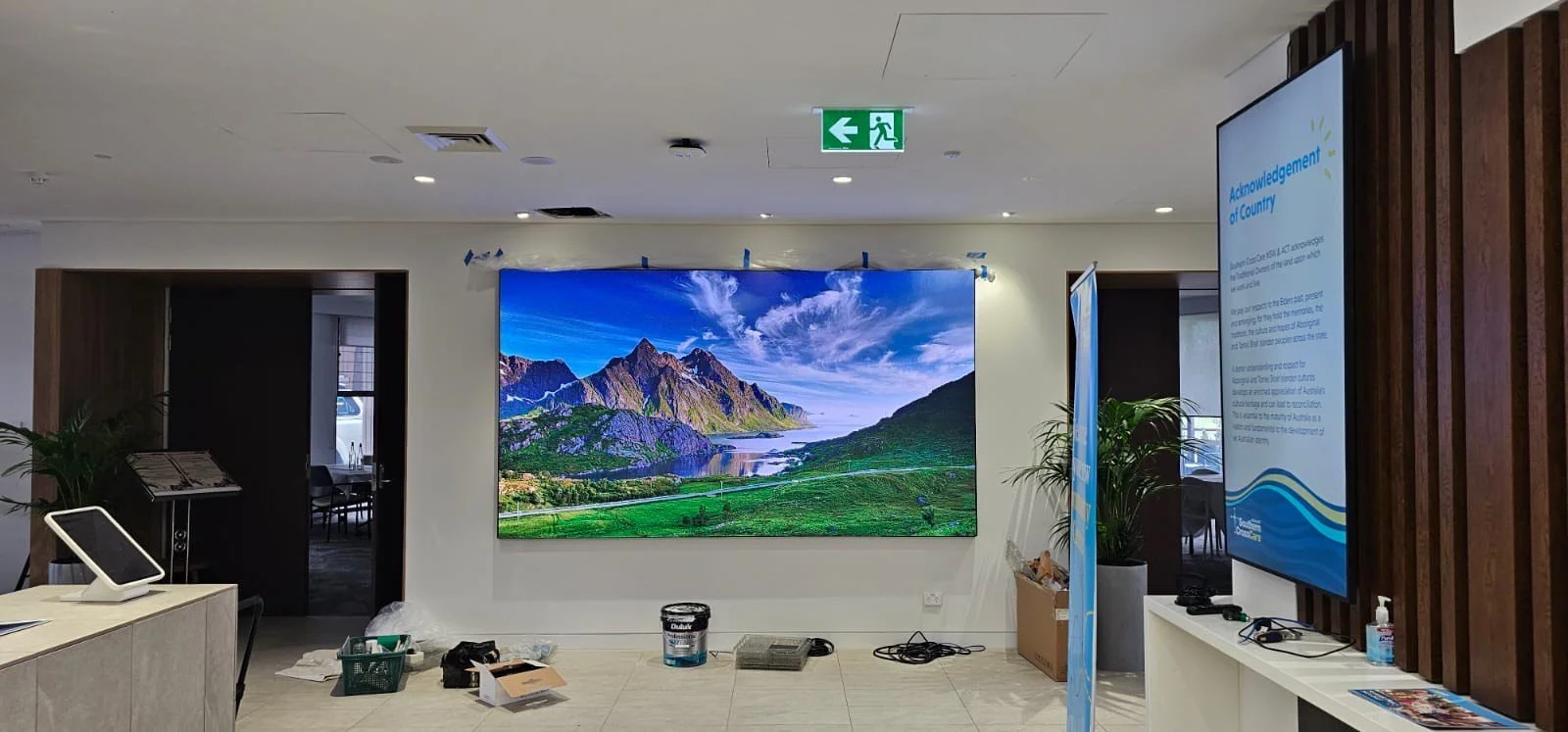
What Makes the Corporate Environment Different from Other LED Applications?
Corporate lobbies combine high ambient light, close viewing distances, and brand-sensitive aesthetics. These requirements demand finer pixel pitch and higher brightness than many other indoor LED environments.
In a large retail environment, a viewer might be 6 to 8 metres away and moving quickly. In a corporate lobby, a visitor sits in reception 2 to 3 metres from the screen with time to notice colour accuracy, pixel structure, and content quality. Refresh rate matters too. Corporate environments are photographed regularly for annual reports and client materials, and a display below 1,920 Hz produces visible banding in professional photography.
Perth CBD commercial towers add a specific brightness challenge. Buildings with large north-facing glazing, a common characteristic of Perth's office tower stock designed for passive solar management, admit significant ambient light throughout the working day. Ambient light levels of 400 to 700 lux are common in these lobbies during business hours. A standard 500-nit display, adequate for a dark meeting room, does not provide enough contrast against that background. Perth CBD corporate lobbies routinely require 800 to 1,200 nits or higher.
24-hour or extended-hours operation adds a thermal management and reliability dimension not present in residential or event applications. A corporate lobby display that operates 16 to 18 hours per day, 7 days per week, needs cabinets with appropriate heat dissipation margins for sustained WA summer ambient temperatures. Three choices define every corporate LED procurement: display size, pixel pitch, and content strategy. All three must be resolved before hardware is specified.
Choosing the Right Size for Your Space
The optimal display size is determined by your viewing distance and content purpose. A wayfinding screen and a brand statement wall have fundamentally different size requirements.
A simple starting formula for minimum display height: divide the primary viewing distance (in metres) by 4. A lobby with an 8-metre primary viewing position warrants a minimum display height of 2 metres; a reception desk display viewed from 3 metres requires a minimum of 0.75 metres. The following table applies this to common corporate applications.
| Application | Typical Viewing Distance | Recommended Minimum Display Height |
|---|---|---|
| Reception desk signage | 2 to 4 m | 0.5 to 1 m |
| Lobby feature wall | 5 to 10 m | 1.5 to 2.5 m |
| Boardroom / meeting room | 3 to 6 m | 1 to 1.8 m |
| Wayfinding directory | 1 to 3 m | 0.8 to 1.2 m |
Physical constraints matter too. Ceiling height caps maximum display height. Structural substrate determines where fixings can go. Cable routes determine how cleanly the installation can be executed. Aspect ratio selection affects content. Standard 16:9 is the simplest to produce content for, but portrait formats or custom wide-aspect feature walls require content produced at non-standard dimensions. Factor this into your creative briefing before finalising display dimensions.
Pixel Pitch Selection for Corporate Indoor Environments
Fine-pitch LED (P1.5 to P2.5) is the standard specification for corporate lobby and boardroom installations in Perth, where close-proximity viewing and brand quality expectations demand high pixel density.
Pixel pitch is the distance between LED centres in millimetres. The minimum viewing distance at which the image appears sharp, rather than showing individual pixels, is approximately:
Minimum Viewing Distance (m) = Pixel Pitch (mm) × 1,000
A P2.5 display requires a minimum viewing distance of 2.5 metres. A P1.5 display can be viewed sharply from 1.5 metres. For a reception desk display where visitors sit 1.5 to 2 metres away, P1.5 or P1.8 is appropriate. For a lobby feature wall viewed from 4 metres or more, P2.5 to P3.9 delivers the right image quality at a significantly lower cost per square metre.
Overspending on pixel pitch is a common error in corporate procurement. A P1.5 display in a lobby where the nearest viewer is consistently 5 metres away delivers no visible quality improvement over P3.9. The additional cost is invisible to every viewer. Match the pitch to the actual viewing distance.
Technology selection also matters for high-traffic corporate lobbies. COB (Chip on Board) LED technology, where chips are encapsulated directly into the substrate rather than mounted individually, delivers improved impact resistance and a flush, anti-glare surface suited to premium fitout environments. It is worth specifying for reception-area displays that receive regular cleaning or close physical interaction. Our indoor LED display range includes both SMD and COB technology options, with guidance on which suits your specific application.
Brightness Specification for Your Environment
Corporate lobbies in Perth CBD towers typically require 800 to 1,200 nits due to significant natural light ingress from north-facing glazing. Standard 500-nit displays wash out in these conditions.
The brightness requirement for your specific installation is determined by the ambient light level at the display location, not by a generic indoor standard. Measure or estimate your ambient lux at the time of day when the display matters most (typically morning arrivals and afternoon client visits in a corporate lobby) and apply the following guidance.
North-facing lobby with floor-to-ceiling glazing: specify 1,000 to 1,500 nits. Mixed-light open-plan reception with some natural light: 800 to 1,200 nits. Interior boardroom with fully controlled artificial lighting: 500 to 800 nits is usually sufficient. Any display partially visible from outside through glass falls under outdoor specification.
Auto-dimming sensors are worth specifying for corporate environments in WA, both for energy management and because a high-nit display at full brightness in a dark evening lobby is visually aggressive and creates an uncomfortable first impression. Sensor-controlled dimming maintains appropriate contrast at all ambient light levels without requiring manual adjustment. For energy efficiency context in commercial building ratings, the Green Building Council of Australia provides guidance on how digital display loads factor into commercial building performance assessments.
Content Strategy and CMS: Thinking Beyond the Screen
The display is only as effective as its content system. Choose your CMS and establish a content schedule before commissioning, not after.
Corporate lobbies typically display some combination of brand video, visitor welcome content, wayfinding directories, corporate communications, and ambient visual content. Each content type has different production requirements and scheduling logic.
CMS requirements for corporate environments: remote publishing from marketing or IT without on-site access, multi-zone capability for different content in different display regions, integration with Microsoft or Google Workspace for scheduling, and role-based access (marketing owns brand content, reception owns visitor welcome, IT owns system settings).
Ensure your creative team produces content at the native resolution of your display. A 1920 × 1080 asset on a P2.5 display with a native resolution of 1200 × 675 will either appear cropped or scaled, neither of which is correct. Content resolution matching is a project management detail that must be resolved before the display goes live. Our content management system service covers platform selection, configuration, and content format specifications as part of the project handover.
Installation Considerations for Commercial Buildings
Most Perth CBD commercial buildings require landlord approval, structural assessment, and electrical contractor coordination before any fixed display installation can proceed.
In a leased commercial tenancy, which describes the majority of Perth CBD corporate occupancies, a fixed display is a structural modification that requires written consent from the building owner or strata manager. Most commercial landlords approve LED display installations with the right documentation: a structural assessment confirming mounting loads, engineer-signed drawings, and evidence of licensed trades. PinnacleLED provides this documentation package as standard.
Structural assessment is required even in buildings where the wall appears robust. A structural engineer must confirm the mounting surface capacity and specify the appropriate fixing system. Electrical works, covering a dedicated circuit from the nearest distribution board, data cabling, and conduit installation, must be performed by a licensed electrical contractor and must comply with the NCC commercial building provisions for fixed electrical plant. Budget for this trade coordination in your timeline: 6 to 10 weeks from specification to commissioning is realistic for a CBD corporate installation, accounting for landlord approval, engineering, procurement, and installation sequencing. Our LED display installation team and project management service manage this entire process.
Total Cost of Ownership for a Corporate LED Display
A well-specified corporate LED display with a 5-year warranty and hot-swap module design will typically cost less to operate over 10 years than a comparable commercial LCD system.
Indicative hardware cost ranges for corporate lobby applications: a reception desk display (0.6 m × 1.1 m, P1.8) might budget $8,000 to $15,000 including installation. A lobby feature wall (2 m × 3.5 m, P2.5) might budget $25,000 to $50,000 including installation and CMS. A boardroom video wall (2 m × 3.5 m, P1.5) might budget $35,000 to $70,000. These are planning figures only; actual pricing requires a site assessment.
What makes premium LED a better 10-year investment: hot-swap modules replace individual failed panels in minutes without taking the display offline; LED lifespans of 80,000 to 100,000 hours exceed commercial LCD at 50,000 hours; modern fine-pitch LED draws less power than equivalent-area commercial LCD. A grey-market import at 40% less hardware cost delivers none of these economics, with no Australian warranty, no local spare parts, and no verified LM-80 data. For a corporate fitout where downtime affects client and staff experience, that is not an acceptable risk profile.
Frequently Asked Questions
-
Yes, but most commercial leases require landlord approval for structural modifications, including fixed display mounting. Review your lease terms and building management requirements before procurement. PinnacleLED provides documentation packages to support landlord approval applications, including structural drawings and load specifications for the mounting system.
-
Premium LED display systems use hot-swap modules, which means individual sections can be replaced without taking the full display offline. PinnacleLED maintains on-site support contracts for WA commercial installations, with replacement modules held locally to minimise downtime. This is the key operational reason to specify a premium-tier system with a local support partner rather than a grey-market import with no Australian service pathway.
Book a Lobby Consultation
An indoor LED display for your Perth office or corporate lobby is a long-term brand asset that deserves the same engineering rigour as any other commercial fitout element. The specification choices (pixel pitch, brightness, CMS, mounting system) are deterministic: there is a correct answer for your space, and it is knowable before hardware is purchased.
PinnacleLED provides Perth-based on-site consultation, engineering documentation, and premium-tier indoor LED display supply and installation for corporate fitouts across WA.
Book a lobby consultation. We'll visit your Perth space, assess your lighting conditions, and recommend a specification that suits your brand, budget, and fitout programme. Get in touch today.
